Science and technology policy in Japan has undergone major changes over the past several years as a result of developments such as the reorganization of government ministries and agencies accompanying administrative reforms, the creation of new funding mechanisms, and the building of collaborative relationships with industry and academe. From a long-term viewpoint, it seems clear that changes such as these are a worldwide phenomenon that is not limited to Japan. The aspect of science and technology policy as "innovation policy" is becoming more pronounced, while at the same time other changes, such as an increased emphasis on strategic relevance, policies with a broader range of application and scope, and the use of a more diverse set of policy tools, are occurring.
Against this background of transformations in science and technology policy, it has been pointed out that the mode in scientific-and-technological-enterprise/knowledge-production has already changed significantly. In other words, whereas traditional science and technology work (see Figure1) was seen as an interaction between knowledge, in the form of "science and technology," and work, in the form of "research," a new paradigm for science and technology work (see Figure2) has emerged in response to the demands of society and the economy in which not only scientific and technological knowledge but also expertise with applied and practical relevance is seen as a key element. If this observation is accurate, an integrated understanding of these changes and their structure would seem to be an important topic for research in the science and technology policy studies.
Our research is based on an awareness of the above issues and seeks to trace the latest developments in science and technology policy worldwide in both theoretical and empirical terms, with the aim of discovering innovative new directions for science and technology policy in the years ahead. In particular, we viewed the recent changes as a process of reorganization of the science and technology policy system (i.e. policy agents, research agents, intermediary institutions, etc., and including functional linkages between them), that is to say as a process of specialization and reintegration of functions related to science and technology policy. We then aimed to conceptualize our observations in general terms and arrange them in a systematic manner. Our project therefore goes beyond mere theoretical research and can be characterized as policy research including a system design aspect.

Traditional work in science and technology consists of two aspects: "science and technology" as knowledge and "research" as activities.
Within this mode of science and technology work the role of science and technology policy is to support "research" in designated areas and to implement and operate research work on its own initiative.
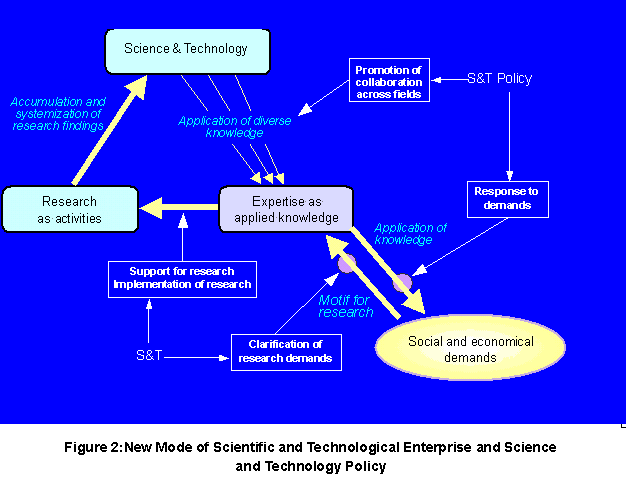
To cope with social and the economical demands, it is necessary to use applied and practical knowledge that matches themes originating from the requirements of society and the economy, rather than to look for applications for scientific and technological knowledge.
Such type of knowledge is different from conventional "science and technology" and can be called "expertise."
Example: Knowledge of the properties of dioxin and how to measure its concentration is conventional "science and technology", while the knowledge needed to enact and implement dioxin regulations is "expertise".
The new mode of knowledge production to meet the demands of society and the economy has the following characteristics:
Science and technology policy must prepare the infrastructure that will allow the above measures to be carried out and must aim to carry out such work on its own initiative.